Twitter is simply a robot message carrier

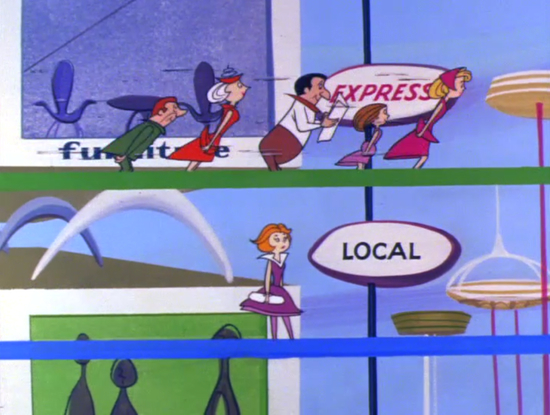
Twitter Local from the 1930’s… from the mobile technology blog, MobHappy. The next time you try to explain Twitter to a patron, say it’s just a notificator. You know, a robot message carrier. It aids persons who wish to make or cancel appointments. Or inform friends of their whereabouts. Like they had in the 30’s. In London. Remember?
Based in the community, but not community-based
How local is local? Interesting post from a great blog I recently stumbled on from Kevin Harris called neighbhorhoods, noting that libraries are “based in the community but not community-based.’
Mapping This and That
Mapping LA’s Neighborhoods: community focused mapping effort from the LA Times…
Welcome to The Times’ map of the neighborhoods of Los Angeles, your portal to our new community pages for the city… These neighborhoods were built with your help… readers didn’t just comment on the boundaries; hundreds sent notes — short essays really — on the places they live. They were informative, humorous, thought-provoking and often eloquent. We hope to keep that conversation going. Please use these pages to tell us more about the places you live.
Know Your Place – Headmap manifesto and the spatialised internet revolution…
The Internet has already started leaking into the real world. Headmap argues that when it gets truly loose the world will be new again.
Geospatial Revolution Project – “the location of anything is becoming everything”…
We live in the Global Location Age. “Where am I?” is being replaced by, “Where am I in relation to everything else?”
Album Cover Atlas… “Word Magazine readers have been busy building this map showing where iconic album cover photographs were taken.”

Hyperlocal Libraries in Netconnect

Library Journal’s Netconnect has published my article called “Hyperlocal Libraries.” I haven’t seen the print version yet, but my article isn’t the cover story, I think it just has the same title as the cover. To give you the gist of it, here’s an excerpt, this is a bit where I start laying it on a bit thick…
Every community is, in its own way, buzzing with activity, and local librarians can dare to press their ears to the hive. There is no shortage of material that locally curious libraries can strive to make more accessible online, from the traditional (oral histories, postcards, death certificates, draft cards) to the more techie (blogs, mashups, tweets). Let Big City Newspaper (if it even survives) serve up Pop-Tarts, while libraries focus on all the different types of bread being baked at home—the things that capture the truly unique personality of their communities and things that will not likely be available elsewhere.
InfoGods, CitySquares, Center’d

Bet there’s a librarian in there… Image from bighappyfunhouse.
MLS Report: Libraries are a Vital Community Resource in the Information Age…
“Libraries build community in many ways,” noted Laurie Brooks, Associate Deputy Director for Library Services. “Whether through preparing children for school, helping small businesses thrive, providing technology training for seniors, or imparting a new language, libraries are essential community resources in the information age. The Library Grants to States program provides an important opportunity to plan and support these vital community-building initiatives.”
CitySquares: Your Neighborhood, Online…
Our aim is to not be just a business directory or city guide, but to be the ultimate resource for local communities. Whether a county in Montana, a borough in NY, a village in Vermont, or a neighborhood in Seattle, we want to get all the information about that community, that locale, online. Get the geopolitical information online, municipal information, local government, post office, libraries, public schools, trash and recycling collection schedules, historical facts, playgrounds, parking lots, public transportation, local school lunch menus, athletic program information, July 4th fireworks locations, and so much more.
center’d… “helps people plan any event or activity, and find new places to go and things to do based on the advice of trusted friends.”
Online Education Database provides a nice list of digital library collections that focus mainly on localized and regional histories of towns, cities, counties, or regions within a given state.
Fighting over Shelley, TownMe, Happin.in

Woody Allen and Romy Schneider in the library scene from the goofy, racy What’s New, Pussycat? The only fight scene ever instigated by the Collected Poems of Shelley? “Sorry, I saw Shelley first!“
9 Ways to Find Twitter Users inYour Town… “Finding local Twitter users to connect with is great for networking, but also for getting relevant, real-time, local information about things like jobs, news, politics, weather, food, and more.”
![]()
TownMe… “TownMe’s mission is to bring all the world’s communities and local information online. With TownMe, anyone can add content to their favorite city or edit any page! Everyone can find something cool, interesting, or useful about their town.”
Happn.in… “Happn.in shows you what people are twittering about in your city.”
“Towards a Theory of Network Locality“… this article from Eric Gordon bowled me over. Nothing to do with LAN’s… “I am suggesting that network technologies and their corresponding practices are significantly altering the nature of local situations, both socially (how we share located information) and phenomenologically (how we experience that which is near).”
Five Friday Links
1. EveryBlock is a hyperlocal site that aggregates local info like news articles, building permits, crime reports, restaurant inspections, blog posts, more. Frustrating bit is that it only covers 15 cities… well, now the source code is up for grabbing. Enterprising local techbrarians can use the code to create sites for their own communities.
2. The inestimable Siva Vaidhyanathan in Publishers Weekly re plagiarism: “We have forgotten that all text relies on previous text—that it takes a library to write a book.”
3. “MetroMonitor: Tracking Economic Recession and Recovery in America’s 100 Largest Metropolitan Areas” from the Brookings Institute.
4. Interesting post about local community sites from Media Transparent, can librarians play a role:
What’s missing from sites focused on a city? Community organizers. It’s the same leadership dilemma facing any organization, whether physical or virtual. Hyperlocal sites need to be driven and organized by hubs and influencers of the local community, and these hubs need to feel invested and committed to their “city site”.
5. Those annoying Geico ads make thier way into the library:
Wikis as Community Hubs

Wikis can be useful for creating community profiles and portals. Here’s a list of cities that have created “city wikis.” It’s easy to do: just take the name of your community (whether it’s a city, a town, a neighborhood, whatever) and stick the word “Wiki” in front of it or “pedia” behind it. Wala!
Of course, then you need to fill that wiki up with stuff… that might prove a bit more time consuming. But not impossible: many city wikis seem to be well populated and dynamic, check out Rochester NY’s RocWiki and Davis CA’s DavisWiki.
Last month, a new service called WikiCity launched. Basically, it’s a place-based Wikipedia: an easy-to-use platform for creating an online community hub, a portal to information about the place you and your patrons call home.
WikiCity covers over 20,000 cities and, despite the name, their main target seems to be towns and other smaller smaller communities:
The concept was initiated late last year, as I have always found that there is something endearing about small towns, and therefore, that is where we started building WikiCity – within towns that have historically been neglected by traditional media.
So, now you have some choices when considering wikis as local tools: you can either create your own city wiki, use WikiCity, or create/modify a city page on Wikipedia.